

Commercial Interior Design Services for Startups & Small Businesses in India
Introduction
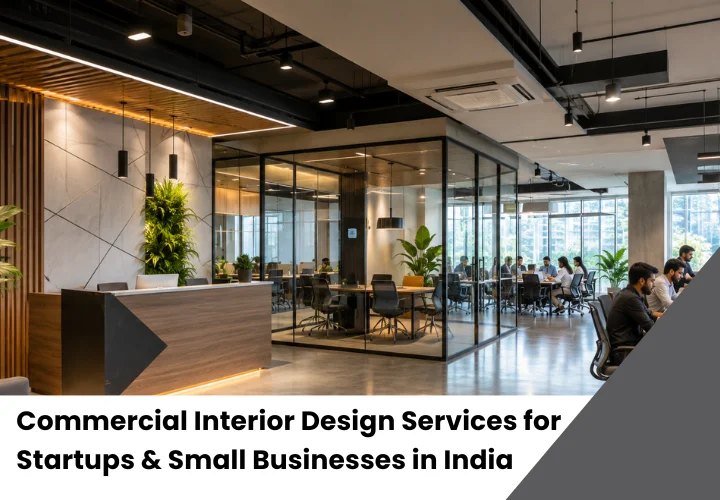
Once you decide to start a business in India, you're faced with multiple challenges, one of which is considering the design and layout of the workspace. Many first-time founders underestimate the significance of this challenge, especially given the time and budget limits common in a business's first phase. But commercial interior design services aren't only for large corporations with big budgets. India's design market has matured enough to serve small and medium enterprises just as well, whether the business is based in a metro like Bengaluru or Mumbai or a growing hub like Chennai or Pune.
Why Interior Design Matters for a New Business
You wouldn't want a workspace that only looks great in pictures. A workspace shapes the way your team works, how your customers perceive you, and how efficiently your business runs day to day. For a new company, the office or store is often the first physical impression a client, investor, or new hire gets.
Good design also affects the bottom line. Spaces with natural light and sensible layouts are known to boost employee focus and reduce fatigue. For retail businesses, layout directly influences customer footfall and how long people stay on the premises, which in turn affects sales.
What Commercial Interior Design Services Actually Include
Most commercial interior design firms in India offer a similar core set of services, though the depth and quality vary widely between providers. Typical commercial interior design services include:
- Space planning: arranging the available square footage so that workstations, storage, meeting areas, and walkways all make sense together.
- Furniture selection: choosing desks, chairs, shelving, and modular furniture that fit both the budget and the brand.
- Color consultation: picking a palette that reflects the brand identity while keeping the space visually calm and professional.
- Lighting design: balancing natural light with fixtures to create the right ambience for the type of business, whether it's a clinic, a cafe, or a corporate office.
- Custom decor: small details like signage, wall art, and branded elements that make a space feel intentional rather than generic.
- 3D visualization: a preview of the finished space before any construction begins, which helps avoid costly changes later.
- Turnkey execution: for businesses that want a single point of contact, many firms manage everything from design to final handover. Tharani Infra is one Chennai-based example, offering turnkey commercial interior solutions that cover office, retail, and corporate fit-outs from concept through to handover.
Some designers also specialize by sector, offering tailored layouts for clinics, laboratories, retail showrooms, restaurants, or coworking spaces.
What Makes India's Market Different for Startups
India's interior design industry ranges from small local studios to large national contractors, with strong regional clusters in cities such as Bengaluru, Mumbai, Delhi-NCR, Chennai, and Pune. While a large industry can feel overwhelming for a founder-run business, much of it is genuinely accessible: firms across these cities are used to fast, cost-sensitive requests, even if that occasionally means trading off on finish quality.
Pricing across India varies mainly by city, size, and finish level. Commercial fit-outs differ almost entirely by the desired finish; a lower finish and a smaller budget typically yield a lower per-square-foot price, and rates in metros tend to run higher than in tier-2 cities. To avoid surprises during the fit-out, ask firms to itemize their quotes rather than give a single lump sum.
Local geography also matters wherever you're based. In Chennai, for example, design firms located in or near key areas (T. Nagar, Anna Nagar, Adyar, Tambaram, and Porur) tend to know local building codes well and can often complete a fit-out more quickly by drawing on established vendor networks. The same pattern holds in most Indian cities: firms with a strong local presence usually move faster than ones commuting in from elsewhere.
How Startups Can Choose the Right Interior Designer
Not every commercial interior design firm is a good fit for a startup budget or timeline. A few practical filters worth applying:
1. Ask for a portfolio of similar-scale projects. A firm that mostly handles large corporate campuses may not be the best fit for a 500-square-foot retail unit, and vice versa.
2. Confirm turnaround time. Startups often need to open quickly. Ask for a realistic project timeline, not just a design timeline; construction and procurement delays are common.
3. Get transparent pricing. Look for firms that break down costs by category (furniture, civil works, electrical, finishing) rather than giving a single lump sum. This makes it easier to trim costs where needed without compromising the project as a whole.
4. Check for warranty or after-service support. Some firms offer multi-year warranties on fittings and furniture, which matters for a small business that can't easily absorb repair costs.
Startups and Small Retail Footprints Across India
Many of India's startups and small retail businesses work with limited square footage (this is especially common in dense metros), so there's a lot of overlap between good-looking design and efficient design. A few ideas that help small spaces feel bigger and work harder:
- Make use of vertical space: wall-mounted shelves and overhead cabinets remove the bulk of floor-standing cabinets.
- Design multifunctional zones, such as a meeting corner that doubles as a break space, instead of dedicating separate rooms to single functions.
- Use light wall colors with reflective finishes; they make compact spaces feel larger without any structural renovation.
- Keep walkways functional and unobstructed; an obstructed circulation path is one of the fastest ways a space starts to feel cramped.
- Include movable, flexible elements such as furniture on castors, so the layout can adapt as the team or business needs grow.
Common Errors Startups Make With Office or Retail Interiors
Many first-time business owners make avoidable mistakes during their first build-out. Getting impatient and starting construction before fully reviewing a 3D layout is one of the most common; it usually leads to costly rework later. Underestimating data and electrical cabling needs is another frequent issue, especially for tech startups.
Planning for growth matters too. A layout designed for five people often feels too small within a year. Where budget allows, building in some flexibility, such as movable partitions, prefabricated walls, or reconfigurable furniture, helps the space keep pace with the business.
Final Thoughts
Commercial interior designing in India is no longer limited to large companies; small businesses can benefit just as much, wherever they're based. Tharani Infra, for instance, is a Chennai-based company offering complete turnkey commercial interior design services for offices, retail, and corporate spaces. Having design, fit-out, and handover managed by one company means an entrepreneur isn't juggling multiple suppliers or absorbing construction delays. With the right partner, even a modest budget can deliver a professional, functional space that grows with the business rather than requiring a full remodel two years in.
A quick comparison of time, cost, and design across a few local firms can prevent most major mistakes. A well-designed space isn't a luxury for a new business; it's a worthwhile investment.